Aluma Learning
Teacher-directed AI coaching made for the classroom
AI-powered learning journeys that amplify teacher pedagogy, deepen student thinking, and dramatically expand real-time feedback.
Aluma Learning partners with teachers to bring tutoring-level feedback, adaptive practice, and metacognitive coaching into daily class time in order to accelerate learning and personalize learning.
—Platform in development
The problem
Teachers today face an impossible tension: they are asked to support dozens of learners with diverse needs, interests, and speeds of learning, yet they are constrained by limited time and rigid classroom structures. Teachers struggle to give every student individual feedback on their higher-level thinking during each class, and they struggle with the amount of time it takes to give detailed, substantial, and timely feedback to the more than 100 students that many teach.
Students often progress through curriculum on a set pace with their classmates, no matter how fast they learn a concept or how much they would benefit from slowing down to understand a concept better. This conveyor belt pacing is hard to avoid even for teachers most skilled in differentiation. Students who need more support are pushed forward in ways that limit their learning and detract from positive identity development. Students who master material quickly are forced to wait to progress, losing both learning and motivation.
In corporate learning and development, companies need employees who can master complex skills, adapt in real-world scenarios, and retain knowledge over time — but managers and corporate educators have the same struggles as K-12 teachers when working with so many employees at once. As a result, they often rely primarily on compliance-driven modules that lead to little long-term learning. Engagement is low, retention is poor, and organizations spend heavily on external consultants without scalable impact.
Both in schools and workplaces, learners would benefit from individualized interactive instruction, regular practice with complex thinking processes, detailed and specific in-the-moment feedback, and adaptive coaching.
Meanwhile, a wave of sophisticated AI tutors has arrived, but classroom and workplace integration remains extremely difficult to orchestrate. Because AI is rarely integrated into classroom structures, students typically turn to AI sporadically for periodic assessment preparation, and because they do so mostly outside the classroom, they often do so in ways that hurt their growth as their outsource their struggle and their creative thinking. AI-powered education tools often demand major pedagogical shifts, offer limited flexibility, or reduce personalization to algorithmically scored multiple-choice questions. Educators are overwhelmed by complexity on one side and underwhelmed by shallow “solutions” on the other.
our Solution

Our platform is a teacher-directed AI integration layer that enables educators in any discipline to adapt learning coaches aligned with their goals while embedding a rich pedagogical model that fosters critical thinking, creative expression, metacognition, ownership of ideas, and long-term retention. Teachers remain in charge: they set priorities and strategies, while the coach provides individualized pacing, real-time dialogue, and actionable feedback without requiring wholesale changes in pedagogy.
The platform also helps educators balance personalization with human-centered learning. Teachers are encouraged to continue integrating social, experiential, and project-based work alongside AI-supported practice. This keeps technology in its proper role: extending instruction, feedback, and practice while preserving the centrality of teachers and the relationships they form with their students.
Early Validation
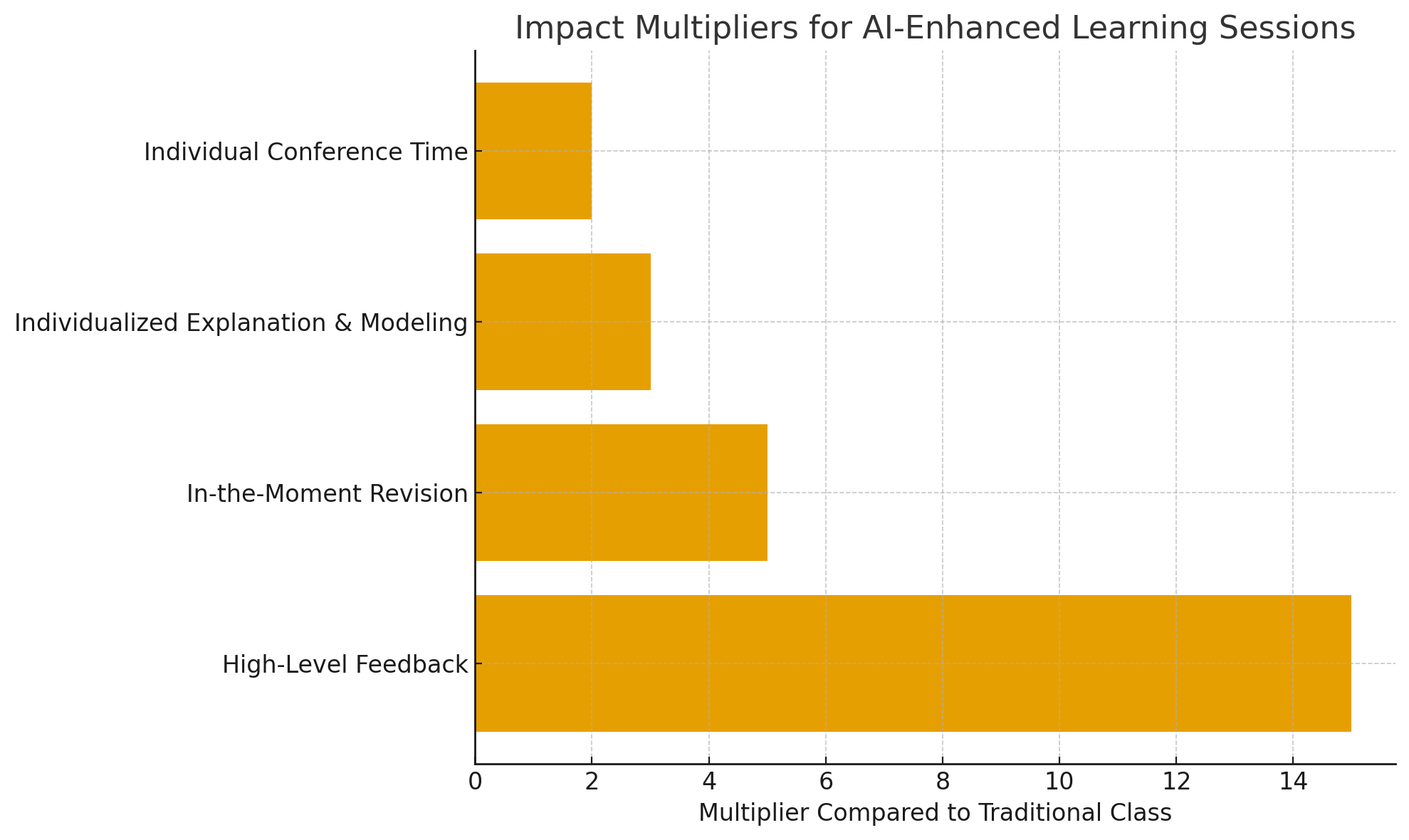
At this stage, we are refining models and measuring impact. In initial architecture validation and prototype trials, we’re seeing:
Dramatically increases in specific, timely feedback per student compared to what is possible with traditional structures in the same amount of class time
Increased cycles of practice and revision
Positive student engagement and feedback
Teacher-time recovery, allowing for more 1:1 conferences during a class period
Positive parent response, with high opt-in rates when the model is explained clearly
Sustained interest from teachers and administrators in the promise of the approach